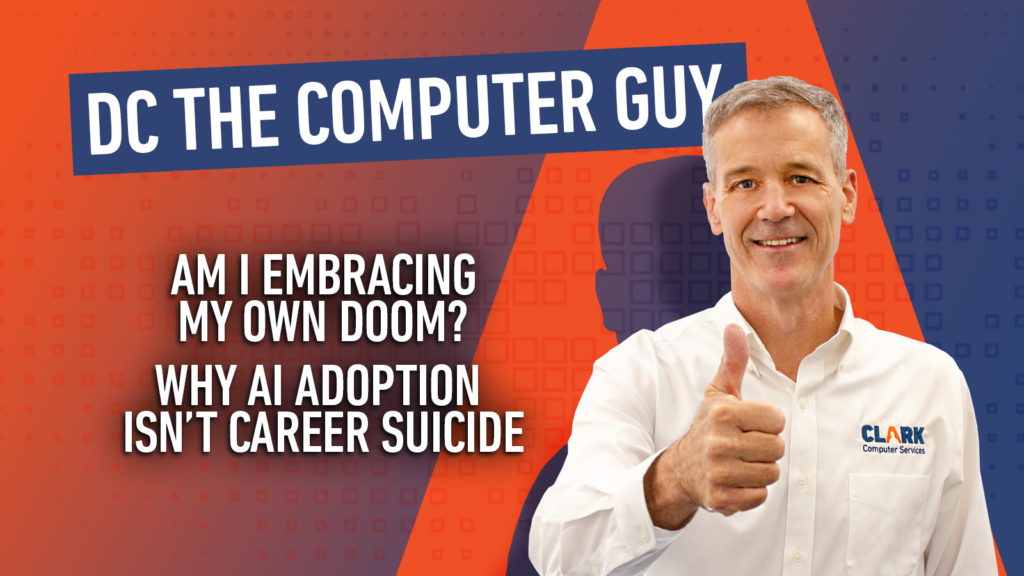
Am I Embracing My Own Doom?
Why AI Adoption Isn’t Career Suicide
DC THE COMPUTER GUY
Do you lie awake at night with questions about AI nagging at you? Perhaps your organization just announced an AI initiative, or you’re seeing your industry shift and wondering if you’re on the right side of it. Maybe, like me, you’re a business leader trying to figure out how to get your team genuinely excited about AI instead of terrified of it. Having doubts is understandable, especially if you keep circling back to the same question: By embracing AI, am I embracing my own doom?
Admittedly, I find myself asking this same question.
Having spent the past 30 years in the technology industry, I’ve built two successful technology businesses and am now in the early stages of growing a third: Clark AI Services. You’d think after three decades and multiple ventures, I’d have all the answers and be confident about where technology is heading. I wish that were the case, but when I look at the pace of AI advancement, and I see how quickly these tools are evolving, I find myself wondering too.
What if embracing AI is me making the wrong bet? Could this path actually accelerate my own obsolescence?
The Fear is Real, and it Cuts Both Ways
If you’re an employee who is resisting AI adoption at work, you’re probably caught between your discomfort and your employer’s expectations. It might feel like learning and using AI makes you complicit in replacing yourself, and even if you’ve decided to embrace it, there’s a quieter fear lurking underneath: Am I building my own irrelevance? And if you’re a business leader, you may be wondering if pushing AI adoption will leave employees feeling threatened or worse, break your trust with them. What happens if the whole AI thing backfires?
Well, I have some thoughts on that. Over the past three decades and through building multiple businesses, I can tell you those fears are legitimate, but we’ve also adapted to every major technological shift in history.
Early in my career, I deliberately chose to embrace change rather than resist it. When IP networks were replacing mainframes, I jumped in. While my contemporaries hesitated, I built experience, deepened my knowledge, and widened my expertise across the industry. That choice, to ride the wave instead of getting buried by it, didn’t just keep me employed; it made me a heavyweight in my field, accelerating my career and giving me the foundation to build not one, but two successful businesses. Now, it’s teaching me how to build a third.
It’s Happened Before and Will Happen Again
Every major technological shift has been terrifying to the people who live through it. The same prophecies of doom and gloom came with the assembly line, Email replacing memos, smartphones replacing desktops, and cloud computing replacing on-premise servers. Technology continues to move forward, and if you’re standing still when it does, you’ll be left behind.
That said, change can be genuinely disruptive. The people who hesitated and asked, “Am I making a mistake?” were right to worry. But when it comes down to it, the people who embraced those changes build a deeper expertise and become more valuable. Changing technologies keep proving to be an opportunity to get ahead of your peers and become the leaders everyone wants to follow.
Advice for Everyone
Here’s where this blog gets practical for both business leaders and their teams.
If you’re an employee, the writing is on the wall; embracing AI now is an investment in your future employability. Every day, AI adoption grows, embedding into every industry, so having AI skills on your resume is essential to your employability. The people who learn to work with these tools will be the ones shaping their industries five years from now. It’s not cheating or getting out of doing work; AI gives you leverage in your job by reducing the time it takes to do something well while increasing the quality of what you produce. That’s embracing a career upgrade, not doom.
On the other hand, if you’re a business leader, your job is more difficult than just mandating AI adoption from above. I’ve watched a lot of technology rollouts fail over the years, and the pattern is always the same. Top-down mandates don’t work without a true bottom-up buy-in. When leadership mandates change without investing in employee understanding and trust, the associated projects stumble or fail. However, when organizations begin with awareness and honest conversations about why they’re adopting new technologies, the success rate climbs dramatically.
Don’t Just Say It, Explain What AI Adoption Means
Handing people a new technology tool and telling them to use it without explaining how is a recipe for failure. People are busy; if the technology doesn’t immediately make their life easier, it gets set aside. We see evidence of this with AI in conversation, on social media, and in headlines.
Explaining it means taking the time to have lunch-and-learns where you’re transparent about your vision. Share your own stories about how you adapted to past changes, and be explicit: we’re not adopting AI to replace you, it’s to augment you. Everyone will appreciate the transparency, but it doesn’t stop there.
It’s important to be realistic about what AI actually is. AI isn’t magic or a way to get out of doing work; it’s a tool that still requires human judgment, human skill, and human refinement. You have to craft careful prompts and review results for accuracy, removing hallucinations and AI-generated fluff. The human role is still essential to actually making AI useful by applying your expertise and knowledge to the outputs.
All That Changes is Efficiency
By embracing AI, you can spend half the time on a task that used to take up all of it, while producing higher-quality work in the process. When your organization is doing more with the resources it has, you’re not replacing people; you’re making the people you have more effective, capable, and valuable.
I see it happening, and now I’m embracing AI across all three of my businesses. Yes, there are times when I ask myself if I’m making a mistake. Still, when I step back and look at my three decades of experience in the technology industry and the pattern of history, the data is clear: people who embrace change come out ahead, and people who resist it get left behind. Leaders who build buy-in for change succeed, while those who mandate it fail.
The fear is human and understandable, but it doesn’t have to be your destiny. If you’re sitting with that same question, “Am I embracing my own doom?”, step back for a moment and look at the pattern. Every generation has faced this challenge, and every generation that chose to adapt has thrived. You’re not alone in this fear, and you don’t have to let it decide your future.
To explore how AI can help your business, give us a call at 301-456-6931 or email [email protected] for a free consultation and see how our experience can help you adapt to and ride this next wave of technology.
Our Industries
Have a Question?
Give us a call
301-456-6931
Our Services
Get a Free Quote
Previous Blogs

Darren Clark
President And Owner
I left big business to start Clark Computer Services in 2003; not because I had a grand vision, but because I had three young children who needed their Dad around. Knowing I had to replace my salary, I went door-to-door visiting small businesses to introduce myself and ask if they needed IT support. I heard story after story from business owners and office managers about IT companies not returning calls and emails, grumpy technicians showing up late or not at all, and systems being down for days, weeks, and in some cases…months. I realized quickly that there was a clear and pressing need for reliable, honest, and professional IT support completed pleasantly and on time.