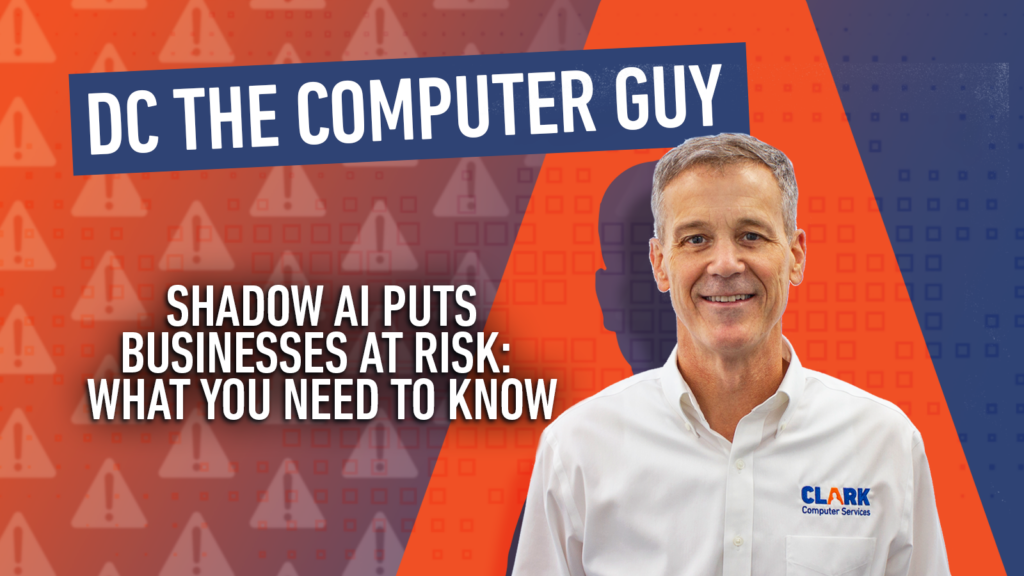
Shadow AI Puts Businesses at Risk:
What You Need to Know
DC THE COMPUTER GUY
Most business owners I talk to understand they need to do something about artificial intelligence. They see competitors using it and know their employees are curious about it, but they’re not sure where to start, and that uncertainty is costing them more than they realize. Because here’s the reality: you may not have an AI strategy, but it’s getting used, and your employees aren’t waiting around for you to catch up.
The Hidden Risk of Shadow AI in Your Business
Without clear direction, AI use goes underground. Your employees are most likely already using tools like ChatGPT, Claude, and others. They’re experimenting, looking for ways to be more efficient, and in many cases, solving real business problems, but they’re doing it without guidance, guardrails, or visibility.
That means files are likely being uploaded to systems you don’t control, and questions are probably being asked about client data, internal processes, or sensitive information. And you don’t know what’s being shared, where it’s going, or how it’s being used. The term for this is shadow AI, and it’s becoming one of the fastest-growing risks for small businesses. So much so that organizations like the National Institute of Standards and Technology (NIST) have already begun emphasizing the importance of governance and risk management for emerging technologies like AI. The reason for this is simple: without oversight, innovation turns into exposure.
When You Lose Visibility, You Lose Control
Shadow AI is a significant vulnerability because it puts your data and your clients’ data at risk. And if something goes wrong, it’s your reputation on the line, not the tool your employee happened to use that day. On top of that, you have no way to measure how often or effectively your employees use AI, or if it’s improving productivity or introducing errors. Employees may be relying on inaccurate information or confidently acting on bad outputs.
At that point, you’re not managing A; it’s managing your business.
AI Governance Doesn’t Have to Be Complicated
When people hear the term “governance,” they tend to picture layers of policies, approvals, and red tape that slow everything down, but that’s not reality. Good AI governance starts with understanding where you are right now, by asking the following questions:
What tools are already being used?
What data might be exposed?
Where are the real risks?
Where are the real opportunities?
Once you answer these questions, governance becomes about defining a clear direction for how you want AI to support your business.
Building a Secure AI Strategy Around Microsoft 365 Copilot
Once you understand how AI is being used in your business and define your goals, the next step is structure. For most small businesses, that structure makes the most sense inside the tools they’re already using. For this reason, we build AI environments around Microsoft 365 Copilot.
Instead of employees jumping between disconnected consumer platforms, Copilot integrates directly into the systems your team uses every day. Email, documents, spreadsheets, and meetings all stay within your environment. That means your data stays under your control and within your security policies. In addition, your employees’ AI usage becomes visible, manageable, and aligned with how your business actually operates.
If you want a deeper look at how Microsoft approaches AI security and data handling, you can find its framework here.
Turning AI Into a Business Advantage
Technology by itself doesn’t solve problems; it requires structure, which is why the process never stops at implementation. That structure includes developing policies your team can actually follow, training employees how to use AI effectively, and providing ongoing support when real-world questions come up, because they will.
Sometimes, structure can be as simple as learning how to build a better prompt. Other times, it’s figuring out how AI fits into a specific workflow or business process. Either way, the goal is the same: make AI useful, not risky. This is the same white-glove approach Clark Computer Services has delivered for over twenty years. It’s about installing technology that works the way your business needs it to.
If you’ve read our other insights in The Clark Report, you’ve seen this pattern before. The businesses that succeed with technology aren’t the ones chasing trends. They’re the ones applying structure.
From Uncertainty to Strategy
Your AI environment shouldn’t be a mystery that happens behind the scenes without your knowledge or a risk you discover after something goes wrong. AI should be a strategic advantage that starts with understanding where you are today, defining where you want to go, and putting the right structure in place to get there.
If you’re unsure about AI, that’s not a problem; that’s exactly where we come in. Give us a call at 301-456-6931 or email [email protected], and we can discuss the training and policies that will help your business manage AI.
Our Industries
Have a Question?
Give us a call
301-456-6931
Our Services
Get a Free Quote
Previous Blogs

Darren Clark
President And Owner
I left big business to start Clark Computer Services in 2003; not because I had a grand vision, but because I had three young children who needed their Dad around. Knowing I had to replace my salary, I went door-to-door visiting small businesses to introduce myself and ask if they needed IT support. I heard story after story from business owners and office managers about IT companies not returning calls and emails, grumpy technicians showing up late or not at all, and systems being down for days, weeks, and in some cases…months. I realized quickly that there was a clear and pressing need for reliable, honest, and professional IT support completed pleasantly and on time.