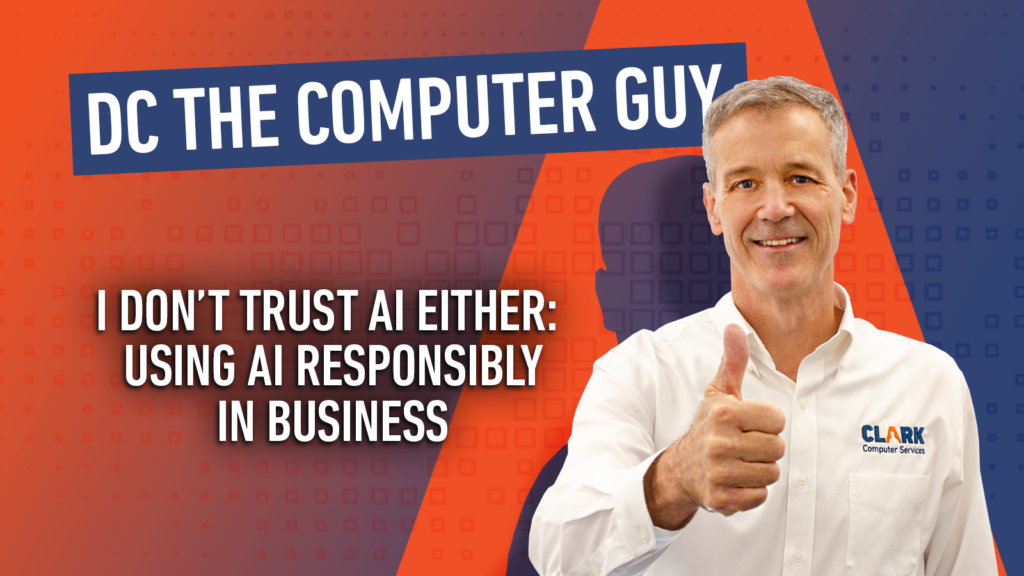
I Don’t Trust AI Either:
Using AI Responsibly in Business
DC THE COMPUTER GUY
I Use AI Every Day With a Healthy Amount of Skepticism
I was at a client site recently, interviewing employees as part of a project, and during one of those conversations, the topic of artificial intelligence came up. The conversation had barely begun when I got the reaction I’ve heard from a lot of people over the last couple of years, “I don’t use AI. I don’t trust it. I haven’t even tried it.” There wasn’t any hostility in her voice; if anything, it sounded more like caution. I know that not everyone is interested in being an early adopter or experimenting with the latest technology, but that wasn’t her issue.
When I looked back at her and said, “I don’t either,” her reaction was immediate: the challenge in her posture dropped away, and she relaxed. I imagine she wasn’t expecting that answer from someone who, as part of his job, is supposed to be the AI guy. It seemed obvious that she expected a lecture about why she was wrong, or maybe a sales pitch about why she should start using it immediately.
Agreeing with her gave us an opportunity to open a dialogue, in large part because it’s true. I don’t trust AI, and I think that’s the right place to start.
Don’t Trust AI and Use It Anyway.
I’ve been using AI tools every day for the past couple of years, and what I’ve found is that distrust isn’t a reason to avoid AI; it’s how you use it well. When you assume the results could be wrong, you stop sitting back waiting for the magic shortcut to make work easier and start being an active part of the process. Doing so, though, means taking on two specific responsibilities:
The First Responsibility is Crafting a Well-Formed Prompt
I follow five components every time I sit down to ask AI for something that matters: context, the task itself, my requirements, the output format I want, and any resources or constraints it needs to know about. If you skip any of these parts, you’ll leave the door open for the tool to guess at what you actually need, and it will guess wrong. It’s the same principle as giving instructions to an employee, or to your own kid, when you make a vague request, you’ll get a vague result. However, when you give them the details they need to succeed, they have a real shot at getting it right.
How much time I spend building the prompt depends on what’s at stake. If I’m putting together a business proposal for a large opportunity that can turn into a multi-week effort, I’ll spend an hour, sometimes two, thinking through and crafting that initial prompt. I take the attitude that whatever I build needs to stay useful and accurate for the life of the project, not just to answer one question. When working with something smaller in scale, I might spend half an hour or so on the prompt. What it comes down to is the size of the investment up front matches the size of what’s riding on getting it right.
The more complex the task, the more I want to get right in that one well-structured prompt, so I don’t have to keep trying to figure it out as I go. I’ll still have follow-up questions for the AI after it provides the output because you can’t avoid those entirely, but, through trial and error, I’ve discovered that a complex task with a vague starting prompt requires many more rounds of back and forth to get to the same place.
The Second Responsibility is in the Review
This component is where I don’t trust the AI and check everything that it outputs. I want to know if the results are factual, written the way I want my business to sound (direct, clear, no fluff), and if any gaps need a follow-up question. When using AI, this is where I spend my time, and it’s where I get the most value.
I recently worked through a contract a mile long for a fairly large project we won. I’ve always been comfortable reading contracts, but this one was dense. Instead of grinding through it line by line, I used Microsoft Copilot inside a secured SharePoint environment, so I could work with the confidential material the way I’m obligated to. I asked specific, structured questions, such as: “How do I properly invoice under this agreement?” “What am I legally bound to?” and “What could create problems for me down the road if I miss it?”
Because I came in with a tight prompt and asked Copilot to reference the specific contract sections behind its answers, the errors I did catch were minor and easy to spot. Some errors I corrected myself on the spot, while others needed a quick follow-up question. Either way, I wasn’t stuck and understood that contract more thoroughly than if I’d done it entirely on my own. More importantly, I was able to get through it in a fraction of the time it would otherwise have taken me.
This is the reason I keep using AI, because depending on the task, I’m seeing my computer-based work cut down to a quarter or half of what it used to take me. Those time savings add up to hours and days every week I can spend focusing on other aspects of business and with family.
Your Distrust Should Be About Security, Not the Tool Itself
When people tell me they don’t trust AI, what they often really mean is they’re worried about sensitive data ending up somewhere it shouldn’t, and that’s exactly the kind of skepticism I want people to have. I’m careful about the data I put into these tools, especially when it comes to personal or protected information, and business-sensitive material, and only use it inside secured environments built for it, like Copilot operating inside Office 365, where the data stays inside a controlled space instead of floating out into a public chatbot. The best practice is to treat the information you give an AI tool the same way you’d treat a phone call from someone you don’t fully know; think before you share.
The dangers of putting sensitive information into a free or insecure chatbot are exactly why I tell every business I work with that awareness training matters. Not a one-time conversation, but ongoing, repeated training so your staff understands what’s safe to put into these tools and what isn’t. It’s that understanding that turns healthy skepticism into safe, confident use, instead of reckless oversharing or total avoidance.
The Wave Is Already Here
I’ll be pragmatic for a second. Businesses and individuals are adopting AI because they see the value in it and people are making money from it, and let’s face it, once those two things are true, nothing stops the wave; it only gets grows. If you’re a business owner, your competitors are already using these tools to produce better work, deliver it faster, or charge less for it. Being competitive in the years ahead is going to mean understanding how to use AI well.
So no, I don’t trust AI, and I don’t think you should either, but that distrust is exactly what should drive you to learn how to use it the right way, with a well-crafted prompt, a careful review, and a clear sense of where the line is on what you share. Do that, and you’re not handing your work over to a machine; you’re using a tool, powered by your own judgment, to do better work faster. It’s the difference between AI managing you and you managing AI.
To discuss how AI can help your business, give us a call at 301-456-6931 or email [email protected] for a free consultation and see how our experience can help you manage this next wave of technology.