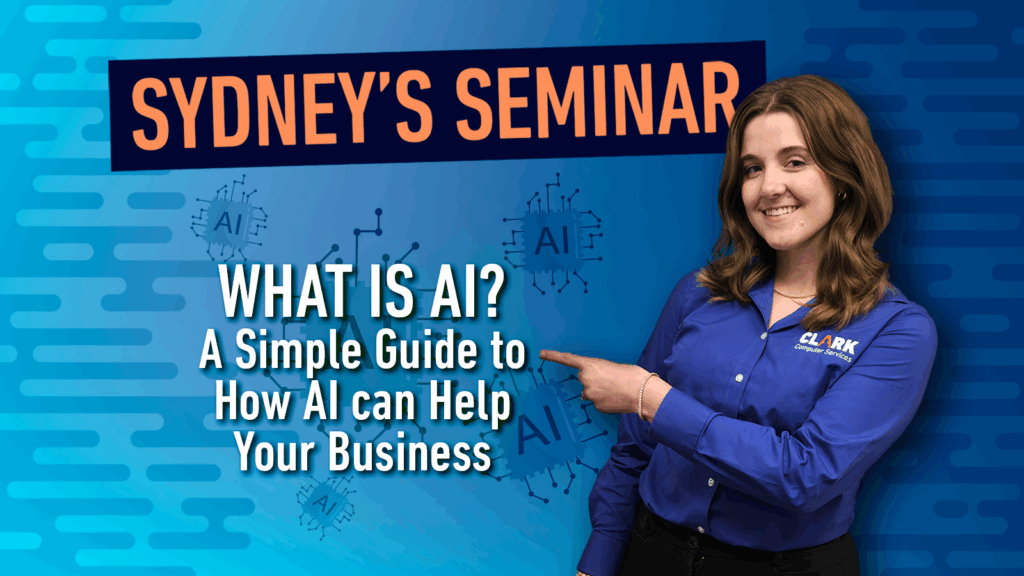
Clients often ask, “What is AI?” and “How can it help my business?” Let’s face it, if you’ve been reading headlines or overhearing breakroom chatter lately, chances are someone’s mentioned AI. It’s one of those topics that seems to be everywhere. People talk about how it’s going to revolutionize the workplace or take over entirely. The truth is neither as scary nor as futuristic as it sounds.
At its core, AI, short for Artificial Intelligence, is just another tool. A powerful one, yes, but a tool meant to help people do their jobs more efficiently. And that’s what I want to focus on today, not robots taking over the office, but how small businesses and employees can utilize AI to make work less stressful, reduce mistakes, and free up time for the parts of the job that actually matter.
Let’s break it down.
What Is AI?
 The name is misleading; it’s not really artificial intelligence. Think of it more as a smart assistant who can handle simple or mundane tasks with a little explanation. Our current AI technology enables computer systems to perform tasks that typically require human intelligence. It excels in tasks such as recognizing patterns, processing language, making predictions, and even learning from its own mistakes.
But don’t worry, it isn’t self-aware, and we’re not on the verge of a robot uprising, at least not yet. This isn’t anything more than an advanced computer program with access to an extensive database, trained to do helpful things faster than we can. A great example is the spam filter in your email. You don’t see every junk message because AI is constantly sorting what’s legit and what’s garbage, based on patterns it learns over time.
Another example?
If you’ve ever used the autofill feature in Excel or gotten writing suggestions from tools like Grammarly, you’re already using AI.
The Real Power of AI: Helping You Work Smarter
AI is unlikely to replace people, especially not in small and medium-sized businesses. For as advanced as it is, AI can’t replace experience, instinct, customer relationships, or the ability to solve a problem in a way no program could predict. What it can do is handle the routine stuff that bogs us down.
The current AI tools we have can help to:
- Organize your inbox
- Summarize long documents
- Schedule meetings
- Analyze trends in spreadsheets
- Catch errors before they go out to a client
As I mentioned before, it’s like having an assistant who never sleeps, gets overwhelmed, or forgets a detail, allowing you to focus on the work that requires actual thinking, creativity, and people skills. Companies like JPMorgan are already using AI to help their employees code faster, not to replace them, but to reduce the hours spent writing repetitive logic.
Closer to home, small businesses are using AI to speed up customer service replies, organize inventory data, and even write social media captions. It’s not doing the job for you; it’s just making it easier to do your job well.
Fewer Mistakes. Less Burnout. More Focus.
One of the most significant benefits noted from AI in the workplace is its ability to help reduce stress. When you’re overwhelmed, mistakes are more likely to happen, including typos in emails, missing attachments, and skipped steps in a process. AI can catch those issues before they become problems. It can also take repetitive, time-consuming tasks off your plate, which helps reduce burnout.
That’s not just my opinion, it’s backed by research. A recent survey showed that employees using AI tools saved around 14 hours per week and felt their work quality improved.
And when you’re not overwhelmed and churning towards burnout, you’re more productive, more creative, and more present with your team and customers.
Why AI Won’t Replace You
 Most headlines and articles touting how AI will replace you don’t understand that AI doesn’t think like we do. It doesn’t understand nuance, tone, context, or emotion. It follows patterns, makes predictions, and refines its answers based on what it’s learned, but it doesn’t make real-world decisions the way people do.
Take customer service, for example. AI can suggest answers to a client’s question, but it can’t pick up on frustration in their voice or go off-script to make things right.
That’s something only people can do.
AI isn’t a Replacement, it’s Reinforcement.
While AI provides tools to do your job better, it still needs a human at the wheel. The best way to get started is to use AI where it makes sense; maybe it’s a scheduling assistant, a smart writing tool, or a system that helps you track customer requests. See what saves you time, where you make fewer mistakes, and how much easier it is to stay organized.
If you’re not sure where to start, check out this great breakdown of AI tools for operational efficiency, or check out Darren’s blog on using ChatGPT in Finance. And if you’re worried about data privacy or security while using these tools, that’s smart. We’re keeping a close eye on that, too, and we can help you figure out which tools are safe to use at work.
AI Isn’t the Future, It’s Right Now
Artificial intelligence isn’t some far-off concept anymore. It’s part of our everyday workflow, and it’s only going to get more useful from here. But here’s the good news: AI is most powerful when paired with people. With your experience, your judgment, and your ability to think beyond the data, it becomes a tool that works for you, not instead of you.
If you have questions about AI tools or want help exploring ways to make your job easier with the right tech, please give Clark Computer Services a call at 301‑456‑6931 or email [email protected].
As your technology partner, we’re always happy to help you make the most of your time, your tech, and your team.