5 Steps to Better Cybersecurity for Protecting Business Data
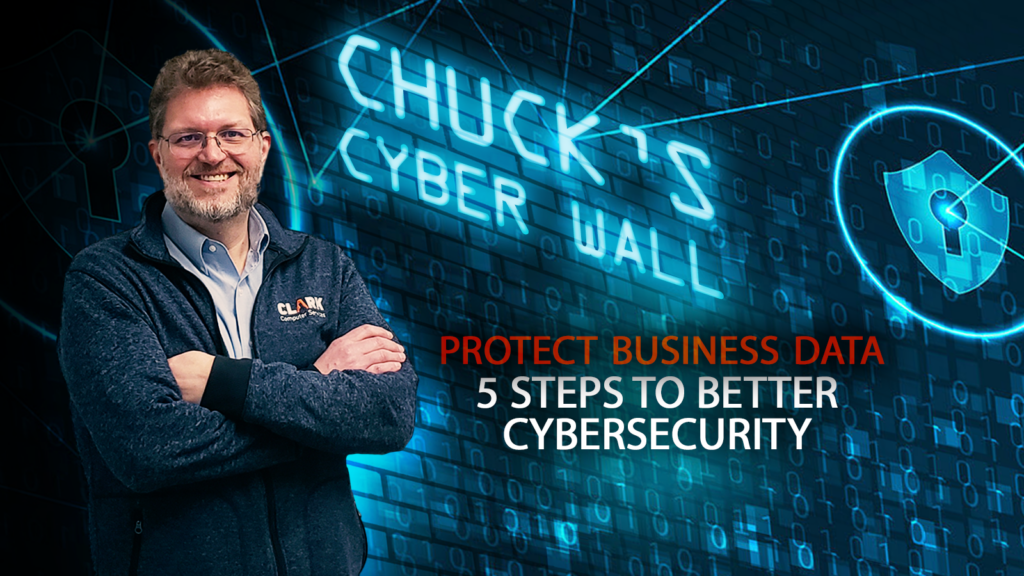
Chuck's cyber wall
With cyber threats dominating the headlines, we get a lot of questions about cybersecurity. Most of them start the same way: “Is this something I really need to worry about?”
It’s a fair question. For a long time, cyberattacks felt like something that only affected large corporations, government agencies, or companies with something obviously valuable to steal, but that’s no longer the case. Today, most cyberattacks don’t target anyone specifically; they’re automated tools scanning for weaknesses, and if your business happens to check one of the boxes, you become the target. It doesn’t matter if you have ten employees or a hundred, limited sensitive data, little access to funds, or no vital services to disrupt, they are attacking vulnerabilities.
What we see most often are not highly sophisticated attacks but simple ones that succeed because the fundamentals weren’t in place. Weak passwords, missing updates, and employees who didn’t recognize a phishing email until it was too late are all easily exploitable. The good news is that improving your cybersecurity doesn’t require a complete overhaul, just focusing on the right areas and being consistent.
Strong Passwords and MFA
Sadly, everything you learned about passwords is likely outdated and has hurt cybersecurity more than it has helped. Short, complex passwords with symbols and forced resets every 90 days don’t hold up the way people think they do. What matters now is length and uniqueness; a strong passphrase that’s easy to remember but long enough to resist brute-force attacks is far more effective than something like “P@ssw0rd!2026”.
For example, my2DoggiesRpawesome! is a 20-character passphrase that uses uppercase and lowercase letters, a number, and a symbol that is easy to remember, and will take hackers 374 trillion years to crack with current technologies.
That being said, for most business accounts, a minimum 12-character passphrase is a good baseline, with longer phrases for anything tied to sensitive data or financial access. But here’s the part that matters more: passwords alone are no longer enough.
Multi-Factor Authentication (MFA) adds a second layer of protection that stops most credential-based attacks in their tracks. Even if a password is compromised, the attacker still needs access to the second factor, whether that’s an authenticator app or a secure code. If MFA is not enabled across your business systems, especially email and remote access, you are relying on a single layer of protection that can be easily bypassed.
Keep Systems Updated and Maintained
One of the easiest ways for an attacker to gain access to a system is through a known, unpatched vulnerability. Software vendors release updates and security patches to fix these issues, but those fixes only work if they’re applied. Delaying updates might seem harmless, especially when everything appears to be running fine, but it creates a window of opportunity that attackers actively seek.
It’s not just your computers, servers, firewalls, network equipment, and even cloud platforms all need to be maintained and updated regularly. It’s so important that the National Institute of Standards and Technology (NIST) highlights patch management as a critical part of reducing cybersecurity risk. Unfortunately, maintenance is too often treated as a performance issue when, in reality, it’s a security requirement.
Move Beyond Traditional Antivirus
For years, antivirus software was the standard for protecting business systems, and while it still has a place, it’s no longer enough on its own. Modern cyberattacks don’t always rely on traditional malware; they use legitimate tools already built into the operating system, stolen credentials, or sophisticated techniques that don’t trigger legacy antivirus software at all.
For those reasons, Endpoint Detection and Response (EDR) software has become the new standard. Instead of just scanning for known threats, EDR monitors behavior on end-user devices, actively watching for unusual activity, identifying potential threats in real time, and allowing for a faster response when something goes wrong. For small businesses, this shift closes the gap between what you think is protected and what actually is.
Understand and Manage AI Usage in the Workplace
Artificial intelligence tools have quickly become part of daily business operations, with employees using them to write emails, summarize documents, and improve efficiency. The problem is that these tools don’t inherently understand what should and should not be shared. Without clear guidelines, it’s easy for sensitive information, such as client data, internal processes, and financial information, to be entered into external systems without a second thought.
Cybersecurity professionals around the world warn that this isn’t a theoretical risk; it’s already happening. Businesses need to establish simple policies on AI usage, including which tools are approved, what kind of data can be used, and what should never be entered. Just as importantly, employees need to understand why those boundaries exist, because when used correctly, AI is a powerful tool, but when used carelessly, it becomes a significant data-exposure risk.
Security Awareness Training for Employees
Secure technology is necessary, but it can only take you so far. Most successful attacks today target human behavior with phishing emails, fake login pages, and social engineering tactics designed to trick someone into clicking, entering credentials, or approving access. For this reason, employee awareness is one of the most important parts of cybersecurity.
Security Awareness Training doesn’t need to be complicated or time-consuming, but it should be consistent and relevant. Employees should know what to look for, what feels off, and what to do when something doesn’t seem right, because when employees understand the risks, they become an active part of your security strategy instead of the weakest link.
A Layered Approach to Cybersecurity
Cybersecurity isn’t about finding a single solution that fixes everything; it’s about building layers that work together. Strong passwords and MFA protect access, updates and maintenance close known vulnerabilities, EDRs help detect and respond to threats, AI policies prevent accidental data exposure, and Security Awareness Training reduces the risk of human error. For small businesses, these steps provide a practical path to improving security without unnecessary complexity, and in most cases, that’s the difference between being a target and being passed over.
If you’re looking to implement or improve your cybersecurity, contact us at [email protected] or call 301-456-6931 for a free quote. We’ll help you build a practical, ongoing cybersecurity infrastructure that keeps your people informed and your business safe.
Our Industries
Have a Question?
Give us a call
301-456-6931
Our Services
Get a Free Quote
Previous Blogs
The Best White Glove IT Support Built for Construction Companies
Beyond Healthcare: How To Protect Client Data with HIPAA Compliance
Holiday Cybersecurity: How To Stay Safe Outside the Office

Chuck Sperati
Director of Cybersecurity and Marketing